Wednesday, April 15, 2015

Coming Home

Tuscawilla Preserve in Springtime ©Lynne Buchanan
It is always such a delight to return to my home and the lovely prairie down the street, especially in springtime when the spiderwort are in bloom.  Here I can see life exploding in brilliant purplish blues when the blossoms are kissed by the sun and open to the world. To wander just a few feet into Tuscawilla Preserve makes me feel as though I am in another world, a world where for a moment I can escape from thoughts about the destruction of the planet and can again believe in rebirth.  Everywhere I look, the earth is carpeted with these delicate flowering plants.

Spiderwort Explosion ©Lynne Buchanan
Tuscawilla Trail ©Lynne Buchanan
The Spanish Moss draped over the sweeping and majestic live oak trees, the ferns, and the cabbage palms all create a beautiful ecosystem that the Native peoples who settled here must have found sacred, and for me it is sacred still...

Spiderwort Portrait ©Lynne Buchanan
I stop in awe at many of the individual expressions of these glorious flowers along the way, appreciating the angle at which their heads tilt, the rich bluish purple of their three petals, the yellow of their six anthers, the unopened buds that will unfurl next, and say prayers of gratitude that this beauty still exists within my earthly home.


Thursday, April 9, 2015

Water, an Endangered Resource, and the Hand of Man

Terra Ceia Restoration ©Lynne Buchanan
We have all seen the frightening photographs of the drought in California and the effect that has had on rivers and waterways.  What we need to realize is that our waterways are suffering all over the country, even in Florida, which we have thought of as the water state for so long.  Our actions directly affect the state of our rivers and springs, which are our lifeblood.  We can choose to act benevolently and try to improve our individual behavior and monitor and clean up what gets dumped in, or we can continue to poison and pollute our water and suffer accordingly no matter what party we belong to.

The image above is part of the Terra Ceia Aquatic Buffer Preserves, just south of the Manatee County Line.  This is the largest habitat restoration on Tampa Bay and when it is complete it will be one of the largest in Florida.  I was so surprised when I arrived there and saw the tidal marshes and wetlands and meandering creeks further in.  I didn't know there was anywhere that had been returned so closely to its original state in Tampa Bay, which is highly developed in most places.  I saw all kinds of birds when I was there and I knew they appreciated how the hand of man had turned back destruction here and given them a place to feed and rest and breed.

Though this marsh looks relatively unspoiled and clean, the water a little further in from the bay itself had much more muck throughout it due to its greater stagnation that allowed pollutants to pool.  After I left and drove further up the coast, I came to a decommissioned phosphate mine that was still clearly leaching phosphorous into the water.  I was able to get close to the runoff while still being on public land and the image below shows what the water looked like.  No doubt this contributed to the point source pollution that was traveling down water to the restoration project.

Phosphate Runoff ©Lynne Buchanan
The water was brown and nasty looking throughout the length of the drainage ditch.  

Industry is not the only thing affecting our waterways.  Agriculture and people's lawns have an equally devastating impact.  A couple of months ago, I was kayaking on the Chassahowitzka River in Citrus County.  The river is one of the more unspoiled ones in the area in terms of shoreline.  The 5-mile long river is spring-fed and many birds, including the bald eagle, and the West Indian Manatee call it home.  I had heard so many wonderful things about it and from the shoreline up it was very beautiful, as was the water near the source of the springs.  However, I did not have to go far to find ailing water and I came across the greatest concentration of green slime I have seen anywhere yet.  

Chassahowitzka Muck ©Lynne Buchanan

This image was made right near the confluence of the Chassahowitzka and Baird Creek.  All three of the images will be at the "Water an Endangered Resource" opening at the Fogartyville Arts and Media Center tomorrow at 6pm.  At the opening, the film "Groundswell Rising" will also be shown.

I hope when people see these images, they will be motivated to examine their own output of toxic chemicals and fertilizers, so that in the future I can focus primarily on beautiful scenes once again. To think we allow our waterways to become so filled with slime is disconcerting and I feel if more people saw what was happening with their own eyes they would stand up for the environment.  I know I would rather leave a legacy of many restorations than choked rivers and streams.


Monday, April 6, 2015

Lead the Youth of Today Towards Stewardship of Our Future: What One Person's Kindness Can Mean

Jeff Coffin and Thomas, Right Before at Bela Flek's Concert and Right Before
Jazz Juvenocracy Left for their First European Tour
I was about to write a disturbing blog about the decimation of water in Florida on the eve of more voting on fracking.  Three of my images have been requested for an exhibition on the challenges facing water. My computer died last week and I am using an old one.  I was looking for the images I am submitting to the show among my downloads so I could write a blog, which I will write tomorrow, and I came across this photograph.  My heart about exploded.  What a moment this was.  I wanted to cry.  The gratitude I felt towards Jeff Coffin is beyond words.  This photograph is before I had any idea how to make an image and it was with a very old cellphone with awful resolution, but none of that matters.  The joy in both their eyes is incredible.

My son, Thomas Silverman, who is now pursuing a PhD in Mathematics at Brown University, is an excellent flute and saxophone player, just like Jeff Coffin.  Tommy had just completed all his college applications and the essay he wrote for the common application was all about the influence Jeff Coffin had on his life.  I knew how much he admired Jeff Coffin and Bela Flek, so I drove him up to Gainesville to see their concert.  Afterwards, we went up to the table to meet the musicians and buy some CD's.  I, being a somewhat over enthusiastic mother (sorry kids), said to Jeff Coffin, "You know my son wrote his college essay about what a great influence you had on his life." Thank goodness Jeff Coffin is a stellar role model and not an arrogant artist who doesn't think kids matter.   He couldn't believe he had been the subject of a college essay and was so honored.  Then he told Tommy to come behind the table with him and said I should take a picture.  He spontaneously did the thumbs up gesture and Tommy beamed form ear to ear.  Then he toldTommy all about the Monreux Jazz Festival in Switzerland, where Jazz Juvencoracy would soon play.  (That invitation was all due to the help of Patrick Moraz–the keyboardist for Moody Blues and Yes and another incredible human and mentor).  In any case, I don't think I have ever seen Tommy so happy in his entire life.  

Looking at this photograph now, as we see our world catapulting out of control due to climate change we cant' speak about and water issues that threaten to drown or parch us, I immediately was struck with what influence we have over the next generation if we take a few moments to talk to them and reach out and support their rights to a better future.  Yesterday, I listened to Maggie Fox's acceptance speech of the award she was given in Colorado as the 2015 Honoree for Celebrating Conservation Women.  During her speech, she urged all environmental groups to establish more programs for youth.  In my own work, on the issues facing Florida's waterways, I am doing my best to engage college students across the state, and hopefully when the exhibition is finished, the museum will bring grade school children out to see it with interactive games and challenges.  Children are the future and we need their help as well as to help them...

I was not a photographer when I made the image of my son and Jeff Coffin, and Thomas has gone on to be a mathematician and not a musician (although the band he played with in Houston in college did record a great CD).  None of that matters.  What matters is that Jeff Coffin recognized Tommy as  a musician, as somehow who had a future, and he reached out to him and in just 10 minutes helped give Thomas the confidence to play across Europe and speak to the crowds in French like a totally empowered being.  This gift, I know, he will carry with him for the rest of his life.  Thank you Jeff Coffin.  I hope I live up to your wonderful example.

Sunday, April 5, 2015

Spirit Cannot Be Imprisoned

Spirit Cannot Be Imprisoned ©Lynne Buchanan

Yellow Iris Emerging ©Lynne Buchanan

Last Easter my beautiful golden retriever, Kaylie, was dying.  She had cancer and I did not know it.  I went to the Easter Sunrise Service in my small town seeking solace and strength.  She passed on in my arms with my eldest son by my side.  In tribute to her beautiful spirit, I am writing this blog.

Yesterday, I went with my new beautiful spirit and Labradoodle, Takoda, which means friend to all, to Kanapaha Botanical Gardens to see the spring flowers.  It was walking with Kaylie in nature and discovering beautiful blossoms and other miracles of nature that I first found God/a higher power/the bigger energy or whatever you care to name it.  The name is not important.  As Matthew Fox says, God, or this spiritual immanence is so much bigger than that.  Just as there is not one way, there is not one name. Though spirit cannot be quantified or labeled or put in a box, it does not mean that ithe spiritual dimension has been stamped out. Try as our society might to banish spirituality from this world and operate on the basis of selfish greed, there is still something larger than all of us and when we open to these mysteries, so much is set free and the basis for true healing of ourselves and the planet can begin.

Though I believe there is hope and refuse to give up, no matter how dire the situation has become in my home State, in the Nation and the World at large, I believe it is time for us all to stand strong and peacefully join hands to show the unity of our desire to topple the old systems in power, which serve only the materialistic desires of a few wealthy individuals and corporations and do not serve the people or the environment they are entrusted with safeguarding.

In Florida, our supposed representatives refuse to ban fracking, they won't use the funds the people voted for to buy land and send the water south, they won't protect our rivers sufficiently from nitrogen and they allow too much water to be taken from these waterways and are draining the aquifer.  These problems are occurring around the country.  I know.  I have hiked to glaciers and followed rivers to where they have totally dried up and seen with my own eyes.  There are sinkholes all over North Florida and the entire State is built on limestone which is highly susceptible to saltwater intrusion and not very stable.  How in heaven's name is the earth supposed to withstand fracking here?  And can we honestly allow anymore toxins into our water?

Since I began my work with water, I have become a spiritual environmentalist who gives voice to the elements through my art and writing.  Here is the rub, as I see it.  I do not know of any truly spiritual person who does not believe that we are entrusted with caring for our planet.  Yet, many of these same people only believe in helping the planet by sending positive thoughts and positive energy. While I totally agree that this is essential and that we must heal ourselves and change society before any lasting reforms will stick, I have come to understand that we do have to engage in this broken world including voicing our objections to the status quo.

For years, I have considered myself apolitical.  I have not gone so far as to fail to vote, but other than going to the polls, I have basically closed my eyes and ears to what is going on.  It was just too depressing and hopeless, I thought.  The water issue in Florida and across the world is changing that for me.  This year, I attended two protests for the first time.  After the rally in Tallahassee to try and get political leaders to use the funds for Amendment I as promised, I met the lobbyist for the Sierra Club.  I thanked him for all he did and apologetically said I was apolitical.  He told me I should realize that if I took that stand I was basically giving the politicians in power cart blanche to make decisions for me.  I had spoken to many that day, and I can tell you abdicating my voice to these people is something I cannot in good conscience do any longer.

For spiritually motivated people, it goes against our grain to become angry, violent activists, which only serves to close the ears and minds of those whose opinions you want to change.  However, this does not mean we should throw up our hands and just think nice thoughts.  I believe our intentions do create the reality we want, but unfortunately, right now, there are a few people who are exercising so much power over the planet and they must be stopped somehow.  No matter how many of us see them in divine light as stepping out of ignorance and into caring for this entire interconnected web of life we inhabit, it does not seem to be happening.  Many of our political leaders and corporate moguls seem not to care what they do to the elements in the pursuit of wealth.  Some even think water is not a human right and that it is just another commodity that can be bought and sold for a profit at the expense of human lives.  This is not a world that I care to inhabit.

The spirit of life cannot be imprisoned.  No matter how many destructive acts we allow like fracking, no matter how many carcinogens we dump in the water, the earth keeps trying to heal itself and flowers keep trying to bloom.   The spirit of life and love and cooperation will rise again, and it will rise more quickly if we stand in unity and make our voices heard speaking from the deepest love in our hearts for the earth, our mother.

Monday, March 30, 2015

A Special Morning Feeling One with the Web of Life in Matlacha

Walking in Unison @Lynne Buchanan
A couple of weeks ago, I had one of the most amazing experiences of my life–the kind that makes me ecstatic to be alive and grateful that the other creatures that inhabit this planet with me are so accepting of my presence.  The day before, I had been photographing the troubled waters of the Caloosahatchee.  I'd stayed over in Fort Myers and decided to take my kayak to Matlacha and see how the waters were faring where the Gulf meets the river.  To my great relief, the water did seem much healthier although there may have been some unwanted algae mixed with the sea grasses.  The winds were very stiff though and it was difficult paddling.  It was pretty wavy too, and I was a little nervous with all my gear.  Then I rounded the corner and found this beautiful sheltered area with more birds than I had ever seen in my life in one place.

Matlacha Menagerie of Birds ©Lynne Buchanan
I watched the birds from a distance, not wanting to disturb them in any way.  I felt if I caused one bird to move by my presence, the magic spell would be broken.  I sat a ways off shore in the middle of the shallow water between the two islands just observing for more than two hours. The birds were oblivious to my existence.  Gradually, I drifted closer, but the birds didn't seem to notice.  They were too busy feeding and working out their own issues.  It was so incredible to observe all these natural behaviors unfiltered.

Feeding and Converging ©Lynne Buchanan


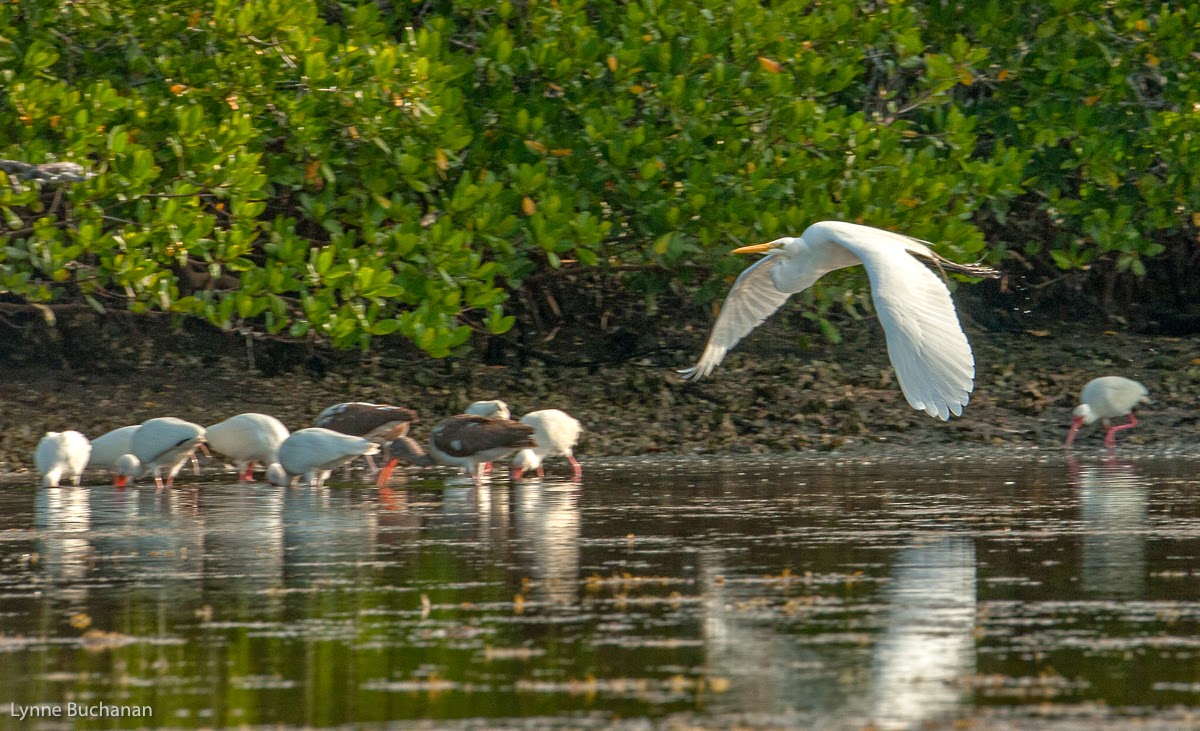
I loved watching the spoonbills open their gigantic beaks and the incoming egrets.  There were little blues, great whites, and immature and adult ibis.  So many species together..

Working out Feeding Together ©Lynne Buchanan
While I sat there listening to their cacophonous sounds and watching them squabble a bit, I couldn't help think that there they were feeding on the same limited resources that we humans do, but they were finding ways to work it all out without killing each other.  I also was so grateful for all the diversity I was witnessing and prayed that what we are doing to the water and the air does not cause more and more species to die off.  This ecosystem was incredible and I was thankful that I was a part of it in my little boat.  I think the birds eventually began to notice I was there, but by the time they figured it out I had been there for so long that I seemed to pose no threat.  I tentative stood up and they didn't care. They even began to fly over my head, when they went from one side and then back to the other.  It was so amazing to feel part of this scene in an included and non-intrusive way.  I almost began to feel like they saw me as another bird, instead of some threatening force that might harm them.  My philosophy is to be an equal part of the web of life, and though I always feel this way I have never felt that other creatures accepted me as such before.

Incoming Ibis ©Lynne Buchanan

More and more ibis kept flying in.


Even a Great Egret Joined the Fun...
Great Egret Landing ©Lynne Buchanan

Every moment something new was happening. All I had to do was be present, pay attention, and appreciate each miracle that unfolded. How birds take off and fly and land is so fascinating. Especially amazing is how they never crash into each other when so many are coming and going all the time, and the ones grazing along the shore are constantly moving as well.  Such amazing synchronized chaos.

Draped Wings ©Lynne Buchanan

Suspended in Flight ©Lynne Buchanan

Ibis In Flight ©Lynne Buchanan

Incoming Formation ©Lynne Buchanan
But there were the quiet birds too.  How I loved the way the Great Blue Herons sat in the treetops meditatively above all the mayhem nearby...

Great Blue Heron Still Life ©Lynne Buchanan
Then I noticed a lone white pelican gliding gracefully on the water in the company of a spoonbill, an egret and a couple of ibis.  The colors of the lone spoonbill were so vibrant in comparison to the pure white of the other birds' feathers.  

White Pelican, Spoonbill, Ibis, and Egret ©Lynne Buchanan


I could have stayed there all day, but I started to realize that I was getting cold...  I had been so enthralled by the spectacle around me that it took a couple of hours before I noticed my fingers and toes were numb.
Mangroves and Oyster Shells, Matlacha ©Lynne Buchanan
Reluctantly I left this special place, with its ecosystem of mangroves, oyster shells, and sea plants still healthy enough to support all these wonderful birds that shared their morning rituals with me.  I left the sheltered area and headed back in the open water towards the park where I had put in.  At one point, the wind was so stiff that I had to get out of my kayak and wade, pulling it behind me in order to make any headway.  The birds need sanctuaries like the one I had visited to thrive, and we owe it to them to keep them pristine.


Thursday, March 19, 2015

A River in Trouble–Reflections from my Kayak Trip on the Caloosahatchee River

Dead Boat on a Dead River ©Lynne Buchanan
A week ago, I went to visit John Capece from the Caloosahatchee River Citizens Association before venturing on the Caloosahatchee River.  We discussed the issues facing the river, which made the list of one of the Ten Most Endangered Rivers in the United States in 2006 and is still in dire straits today.  In fact, John has been working to raise awareness of the river's problems for much longer than that.  Though I have learned that the issues common to all Florida Rivers have to do with too much nitrogen and the alteration of flow, John said, "You can blame cities or you can blame agriculture, but it really comes down to too many people."  The too many people issue was clearly evident on the Caloosahatchee as you will see in the images below.  There are farms, groves, and people's over-fertilized lawns abutting the river directly, with no easements and only a few oxbow restoration projects.  Everybody is using the water and dumping into it, either directly or through runoff.  The Caloosahatchee suffers greatly from agricultural run off, waste water issues, and releases of too much freshwater from Lake Okeechobee, instead of allowing the water to go South to the Everglades where it is needed.  This river is a wake up call for all Florida rivers.  No matter how much our government tries to downplay the water issue, Florida rivers and springs are in serious trouble.  I have included a couple of images that show restoration projects and  the potential beauty of this river the hand of man has altered so much.  However, given what I experienced on that river, a lot more is needed than a few more oxbow projects, though they do help a bit.  The water quality of the entire river must be addressed and quickly.  The color of the water was awful and by the end of the day, my eyes were burning and my throat was sore.  

Oxbow Near Alva ©Lynne Buchanan


Oxbow Near Horticultural Fields ©Lynne Buchanan
The first Oxbow is soon after the Alva Bridge and in parts there was only a narrow path left through the vegetation.  The second Oxbow is just past the horticultural fields and had houses along it just before the dead end here. The map showed it as having an outlet that has totally filled in with plant life, no doubt related to excess nitrogen levels.  

The photos below are examples of point source pollution along the river.  The first is from horticultural fields and the second is a pipe running through someone's backyard, which has fertilized grass growing right up to the river's edge as well as boats and cars in the yard.  To me, this image confirmed John's statement that people are a big part of the problem too...  I should also mention that the local farmers and citizens who live in this area are not the ones purchasing the flowers.  It is a big business shipping flowers for a profit.


Horticultural Point Source Pollution ©Lynne Buchanan

Living Too Close to the Edge ©Lynne Buchanan
When I kayaked parts of the river, I saw horticultural fields and orange groves growing right down to the river, and in the other sections I drove along, there were fields with cows directly across the road from the water.  More than any river I have been on, this one showed me the dangers of not having easements.

Orange Groves Along the River ©Lynne Buchanan

The net result of so many people engaging toxically with the river was some very sad looking water. This image was made on a little island right by the first oxbow.  Green slime was attacking the twigs, which there weren't very man of, which turns out to be a very bad thing.  Rivers need twigs and leaves in the water for nutrients, but algae and slime decompose them too quickly.   The constitution of this water made me a little nervous about paddling, as you accidentally end up ingesting water that gets on water bottles or on your hands.  By the end of the day, I felt pretty badly.  Hopefully, the effects aren't permanent, but I can tell you I wouldn't want to drink water coming from this river unless someone could guarantee that it had been safely treated though I am not sure I would believe such claims–not necessarily because it can't be done but because I suspect people try to cut corners to save money and they are starting with some pretty sad water.  
Sad Water ©Lynne Buchanan


Olga Water Treatment Plant ©Lynne Buchanan
The image above is of the plant for the last remaining surface water source along the river.  The agencies in Lee County, according to John Capece, want to "shift everyone to groundwater since that eliminates a public relations headache with the water plant closing down each time there is a water quality episode (salinity or algai toxins)."  On this river, I can imagine there would be quite a few closings.  

Matthews Creek Flowing into the Caloosahatchee ©Lynne Buchanan

Grasses with Algae, Matthews Creek ©Lynne Buchanan
In addition to problems with the Caloosahatchee River itself, many creeks that run through farmland carrying more fertilizers and waste products also flow into the river.

Abandoned ©Lynne Buchanan

We and the River are Part of a Web ©Lynne Buchanan
Kayking on the Caloosahatchee left me with such an odd feeling of abandonment and destruction, compared with the usual feeling of peace and alignment I experience.  Boats and buildings along islands dotting the ailing oxbows made me realize that people who once fished and interacted with the river  in a healthier way had moved on, realizing the water was dying or was already dead, while the majority of people who remained were using her irresponsibly.  When I took a hike along the Caloosahatchee Creeks Preserve East on the new trail to the river across from the power plant, I came across this spider web on some branches overhanging the water's edge.  This image spoke so powerfully to me about how we and the river and the riparian landscape are all part of one web. What we do equally impacts the health of the river and our own health.  

Oxbow in Ft. Denaud  ©Lynne Buchanan

Restored Oxbow 24 ©Lynne Buchanan
As I believe it is always important to end on a hopeful note, even when the grounds for hope might be slim, I am ending this blog with some photographs of oxbows that have been not been destroyed and/or have been restored.  The river must once have been beautiful, like all Florida rivers.  This waterway has been over-utilized and cannot be brought back to its original state because too many people own the land around it, but that does not mean that we shouldn't try to improve its water quality and bring it back to the best it can be at this point in time.  We can turn the tide, if we all act together and demand that our political system works to protect our environment and our health before it is too late and all our waterways are irreparably harmed.


Thursday, March 12, 2015

Withlacoochee Wonderment


Clouds and Trees Calling Me Home on the River ©Lynne Buchanan
A few days ago, I set off on a short three and a half hour paddle on the Withlacoochee around 3 in the afternoon.  The trees along the quiet riverbanks were majestic and delicate at the same time and there were some incredible backlit clouds.  The way all these elements were converging was dramatic and I knew it would make a great black and white because there were so many shades of gray.

As soon as I got on the river, I knew it was probably a little too fast for me–especially since I was carrying all my expensive gear.  A short ways up from where I put in at the campground and RV park, I could see the remnants of rapids, which would no longer have been much more of a threat if the water was lower.  Photographing was an incredible challenge.  I had to whip out the camera from the dry bag, where I religiously kept it this time in case I tipped, remove the lens cap, focus, and shoot, all the while being aware of exactly how far and fast I was drifting and where all the snags in the river were, as well as the location of any potential trees I was careening backwards towards.  I seriously thought about turning me back and getting off the river, but the clouds and trees in the photograph above kept calling me onwards. 

It dawned on me that this was much like the trajectory of my life of late, and actually that of the planet's as well.  Things are happening so quickly and are threatening to spiral out of control unless we keep orienting ourselves even in the midst of extreme circumstances.  Giving up is not an option, unless we want to be flipped and drown.  Instead of being horrified or frightened and collapsing under the weight of it all, it seemed best to embrace this crazy adventure and make the most of the wild and scenic river.  I had to trust that my paddling skills were way better than I'd previously thought.  Perhaps if I believed in myself, I would survive.

Entering the Maze ©Lynne Buchanan
I was paddling so hard my arms hurt and each time the river narrowed, it became even more difficult to make forward progress.  Periodically, I had to find little spots off the main river where the water was still and just breathe.  This was one of those rest spots.  The reflections were so vivid that it was difficult to see what was actually going on beneath the surface of the water.  I felt like I was entering a maze that might have no way out and paddled very slowly, to make sure I didn't get hung up on a stump or that I didn't run into any of the plentiful spiders.  

Trees Limbs Dancing on the Water ©Lynne Buchanan
Reflections are so interesting.  Sometimes they are crystal clear and logical, while other times they take on a life of their own, evoking a sense of mystery and movement that is irreducible.  The trees above were still, but the speed of the water made them seem to dance and shimmer, showing me visually the Whiteheadian interconnectedness and interdependence of being.  The reflections of the branches were simultaneously solid and fluid, while the leaves were effervescent.  

Evening Serenity on the Withlacoochee ©Lynne Buchanan
This last photograph is my favorite.  The water is still moving quickly; a fish has jumped; the golden light is gently caressing the feathery leaves; the reflections compliment the incredible beauty of the riparian landscape, which has invited me in and is holding me in its magical moment of perfect serenity even though the water is moving just as quickly as when I first entered. (In fact, when I returned the woman who owned the campground told me she'd been worried all afternoon that something would happen to me.) My senses were fully aware of every tree and branch of this spot that I had first visited on my way upriver and had returned to now more confident and attuned.  Any trepidation I had experienced earlier was gone and I was at one with my surroundings.  When this happens in nature, there is nothing more rewarding or regenerating.  I whispered thank you to all the elements and to my own senses for their ability to take it all in.