Sunday, January 18, 2015

Never Be Too Jaded to Appreciate Amazing When You See It

Sarasota Bay, My Lifeblood ©Lynne Buchanan
This one is for you, Dad.  When I was at my parent's house over the holidays, my father suddenly yelled for me to grab my camera quick and go outside.  My father is 84-years-young.  He has been living in this house on Sarasota Bay since I was 11 years old and I hate to say how long ago that was.  Anyway, let us just say he has watched a lot of sunsets.  When he called for me, he sounded very urgent.  I have been his daughter for a long time, so I understood the timber of his voice.  I snatched my camera and ran out through the sliding glass doors without thinking twice and saw this.  I truly about fainted.  It was like the sky and water were bleeding.  When I was done photographing and came inside, my father said he had never, ever seen a sunset like this in all his years on this planet.  This is the view from his backyard, so he sees sunsets every day.  

A photographer I know once told me that she never photographs sunsets.  They are too cheap.  I suppose she meant easy.  The colors are there and if you expose them right, you can make great images–especially if you modify the colors a bit in Photoshop or some other program.  

Perhaps she had a point, but her point was only valid if it is necessary for you as the photographer to prove that you are exceptionally skilled and that nature has only a small role in your creation.  Frankly, if you don't want to photograph something like this and burn this visual in your mind forever to call upon in times of stress, medical hardship, loneliness, challenge, whatever, you are crazy.   Let me just say that I did not modify the colors at all, except to back them off a little because it was too intense to be believable.  Sometimes we get so incredibly jaded.  Sunsets happen every day.  Why should we care? 

All I can say to that is that to me, each time the sun rises or sets it is a miracle, no matter how dramatic or not it is.  When I see something like this, I just want to scream and jump up and down with joy, amazement, love, and gratitude.  I don't know about you, but this is why I am here on this planet.  To show up at moments like this and thank God I can still feel my blood course through my veins a little faster and the air fill my lungs a little deeper.  

We are only here for a short flash, like this incredible burst of color, and then we are gone.  Sometimes, I wonder how long that will be and consider counting the hours, minutes, and seconds, but that is pointless, I know.  It is not up to me when it will all end.  It will just happen sometime.  This weekend was my 40th high school reunion and I was saddened to see how many of my peers had passed on.  I was also grateful how many people showed up–an amazing percentage actually considering how small the two classes they combined were.  I wasn't going to go, but then I did because I figured how many 40th high school reunions can you have.  I was so glad I attended too.  Memories were triggered, friendships reignited...

Sunsets like this, momentous high school reunions, all these things are fantastic and mind blowing and I applaud them.  But the little moments, the not so spectacular sunsets, the quiet intimate exchanges we have with life, they should be treasured too.  Sunsets are not cheap.  No aspect of life is without the greatest worth.  Celebrate every single moment you have and let go of your expectations of how fantastic things should be.  Sunsets like this happen when you least expect them.

Saturday, January 3, 2015

Thoughts on "The Death of The Creative Artist–and the Birth of the Creative Entrepreneur"

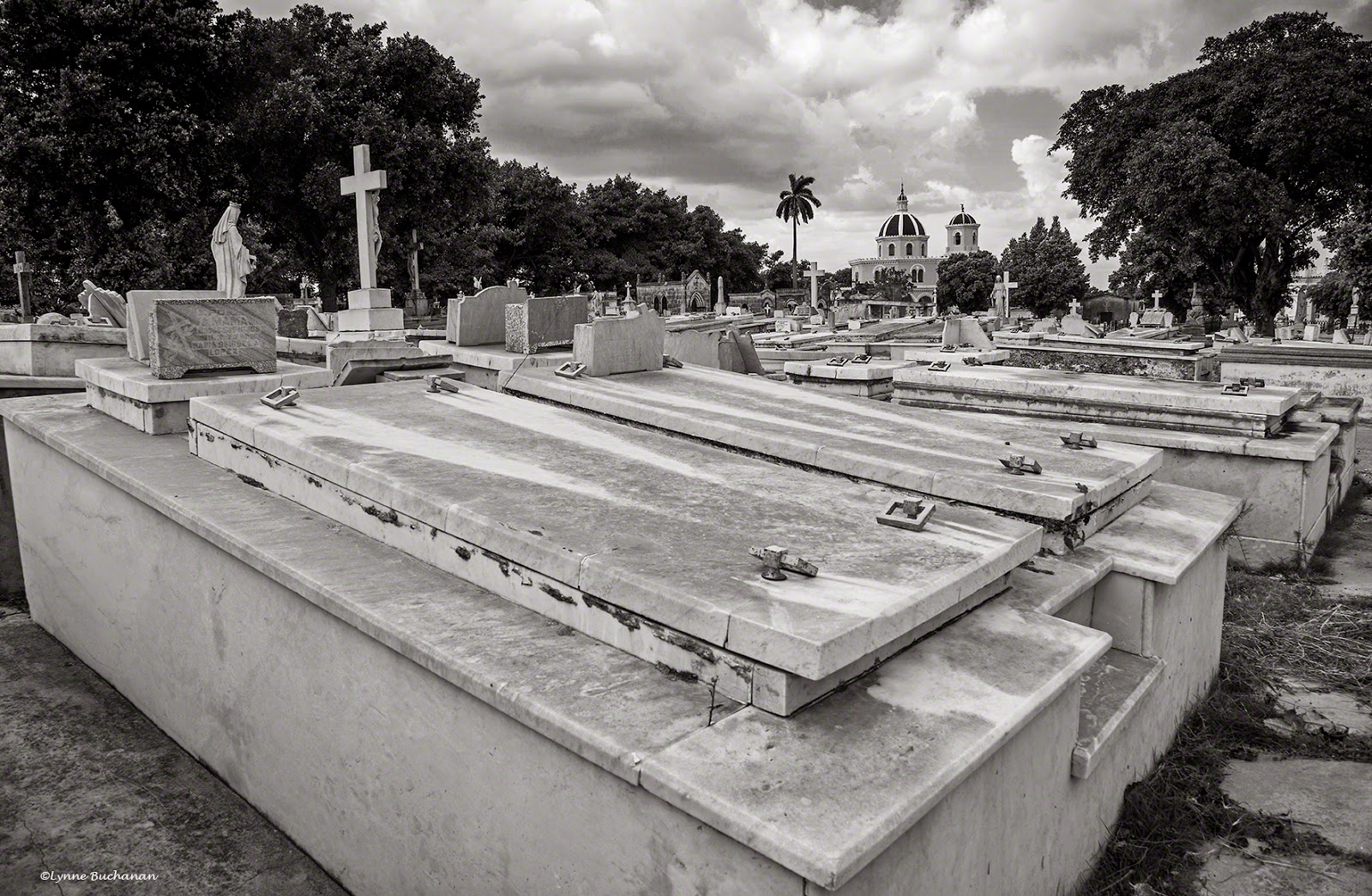
Colon Cemetery, Havana ©Lynne Buchanan
In William Deresiewicz’s article The Death of the Artist—and the Birth of the Creative Entrepreneur in The Atlantic Monthly, he writes about how works of art are becoming commodities–consumer goods with a customer base.  From my own struggles to hold on to what I am trying to express with my photographs and blog posts while trying to market and sell my work, I tend to believe a lot of what Deresiewicz’s article is saying.  This paradigm shift he tell us has to do with the shift in the workforce.  No one is guaranteed a job these days and people have to switch careers multiple times.  We are in an age of entrepreneurialism where we are all being forced to become our own “marketing production, and accounting departments.” Deresiewicz writes that although entrepreneurialism is being sold to us as an opportunity, it is actually a necessity. 
The author suggests quality will deteriorate because no one has time for the 10,000 hours it takes to become really expert at something because of the demands of all these other roles.  In addition, Deresciwicz observes that in searching for a market, creative people are hitting multiple media and establishing platforms for their creativity instead of focusing on a single art form. Though I constantly feel the pull between creating and marketing, I spend most of my time creating and not enough time marketing in large part because I don’t understand how to market the work my soul feels compelled to create since the world of photography has changed so much.  It is also true that I had to incorporate writing to get my work and message noticed and there is no doubt that pursuing two creative media is very time consuming.  Yet one more reason marketing is the last thing I get to. Furthermore, it seems to me that the skills required to create photographs and write creative nonfiction are very different than the skills required for running a successful business.   Achieving success in today’s art world is a mix of creating something “artistic” and being able to sell it, with the business model often being a greater indicator of success. 
My photographs and writings reflect my inner awakening and I have shared them in an attempt to help shift cultural values, so that people understand we are part of a web of life and owe it to the planet to consider the consequences of our behavior towards nature.  Though there is clearly a need for my message in today’s world in my humble opinion, since we are destroying the environment at breakneck speed, this need is not something recognized by much of society or deemed relevant in the new paradigm of the artist. 
I am not interested in selling for the sake of selling, in producing without caring what I produce just so someone will consume.  To me, art is more than a widget.  Yet, if I cannot find ways to sell or share my work in museums, galleries, and public places without losing money as I currently do, I may have to stop displaying my work in these forums and create solely for myself. It is somewhat paradoxical that in this new age where everyone is supposed to have a voice, your voice is deemed less worthy if you don’t follow consumer trends and market your follower voice sufficiently through social media and other networking platforms.  Don’t get me wrong, I do share through Facebook, as it is the best means of reaching people I have found and with no advertising, my blog has been read more than 11,000 times.
Still, I have yet to figure out how to cross over from getting people to look at and read my work to earning enough money to cover the costs of sharing my work.  Though the reason I am an artist has little to do with making money, or I would have quit long ago, it is disheartening not be compensated sufficiently for the blood, sweat, and tears I put into my photography and writing in a world where everyone is trying to get the best deal on a product.  Yet, as someone said to me the other day about the starving artist story, “I don’t want someone trying to make me feel badly that I don’t want to buy something if I don’t need it or want it.”  In the past, there were patrons who funded creative endeavors because they saw the value to society.  Now we have to prove and create our own value.  For a long time, I have thought if I could just become well known somehow, then my work would sell easily because critics and other artists are always telling me how good it is.  Yet the point of creating has never been to become famous for me. 
I am not sharing my struggles to make anyone feel sorry for me.  I have been analyzing them for a while and this article helped me see what I have been facing in a cultural context that affects the direction art may go in the coming decades.  As someone who believes in the soul and the importance of art in opening our eyes to the deeper issues of life, I feel examining these issues is critically important.  
Below are three quotes from the article that I felt raised particularly significant issues.   To read the article in full, click on the link below: http://www.theatlantic.com/magazine/archive/2015/01/the-death-of-the-artist-and-the-birth-of-the-creative-entrepreneur/383497/?single_page=true
 “It’s hard to believe that the new arrangement will not favor work that’s safer: more familiar, formulaic, user-friendly, eager to please—more like entertainment, less like art. Artists will inevitably spend a lot more time looking over their shoulder, trying to figure out what the customer wants rather than what they themselves are seeking to say. The nature of aesthetic judgment will itself be reconfigured. “No more gatekeepers,” goes the slogan of the Internet apostles. Everyone’s opinion, as expressed in Amazon reviews and suchlike, carries equal weight—the democratization of taste.”
“’Producerism, we can call this, by analogy with consumerism. What we’re now persuaded to consume, most conspicuously, are the means to create. And the democratization of taste ensures that no one has the right (or inclination) to tell us when our work is bad. A universal grade inflation now obtains: we’re all swapping A-minuses all the time, or, in the language of Facebook, likes.”

“When works of art become commodities and nothing else, when every endeavor becomes “creative” and everybody “a creative,” then art sinks back to craft and artists back to artisans—a word that, in its adjectival form, at least, is newly popular again. Artisanal pickles, artisanal poems: what’s the difference, after all? So “art” itself may disappear: art as Art, that old high thing. Which—unless, like me, you think we need a vessel for our inner life—is nothing much to mourn.”

Note: Cuba has been incredibly supportive of the arts, as I learned on my recent trip there.  I only included the photograph above because the Colon Cemetery is so vast and evokes the scale of the loss I believe we are experiencing.  

Sunday, December 21, 2014

Life and Death in the Desert and The Intelligence of Nature

Desolation in the Desert ©Lynne Buchanan
In the process of writing my book, I have come across many photographs I made during my cross country journey that are striking a chord with me now.   Sometimes people succumb to the mistaken impression that they are more powerful than nature.  Yes, the hand of man has done many things to harm the environment by being out of balance, but when it really comes down to it nature is more powerful.   These ruins were from the town of Kelso.  Today, the mission revival style former depot located down the street serves as a visitor center, while this is what has become of the town around it.  I am not alone in being fascinated by ruins; many people are drawn to them likely because they show what becomes of the havens we construct to "protect" ourselves from the elements the instant we begin to neglect them.  Nature can be harsh and inhabitable for human beings when we don't work with the environment.

Sunrise, Mojave Desert ©Lynne Buchanan
Though there are hardly any people residing or even visiting the Mojave National Preserve, in comparison with other National Parks, it is teeming with life.  In fact, the Mojave Desert is one of the most diverse places in the entire southwest in terms of wildlife, with 38 species of amphibians and reptiles, 50 species of mammals, 300 kinds of birds, and even a native fish in the two ponds within the preserve.  In the springtime, there are carpets of desert sand verbena and dunes evening primrose, but even in the fall the desert plants were abundant and beautiful though non-flowering.  This sunrise was one of the most spectacular moments of my journey.  To get to the Mojave Desert, I'd driven straight through on I-5, the real wasteland, from Redding to Nipton.  The moment I got out of my car and stepped foot on the desert, I could feel the energy of all the life around me.

Joshua Trees, Mojave Desert ©Lynne Buchanan
Even after the sun had risen, nature continued to put on a magnificent show that morning, as dramatic clouds filled the sky and the light was soft enough to subtly illuminate the desert floor studded with Joshua trees and the mountains behind.  Yucca moths lay their eggs in the pollinated flowers of Joshua trees and disperse the seeds, while 25 bird species nest in them, and lizards and other invertebrates use them for shelter.  These tree homes look in much better shape than the houses the gold miners built and abandoned.   Afterwards, I visited the cinder cone lava beads and the Kelso dunes, before heading on my way to the Grand Canyon.  There is something that speaks to my soul when I see plants and animals survive and thrive in seemingly hostile conditions, and I know it is because they have learned to work with the environment instead of fighting against it...


Friday, December 19, 2014

A Recent Excursion on the St John's River Near Blue Springs...

St. John's River Near Blue Springs ©Lynne Buchanan
A couple of weeks ago, I went kayaking on the St. John's River to make some images for my upcoming river exhibition.  I rented a cabin in Blue Springs State Park and put in the river right there, paddling up towards the Hontoon Island landing, although I didn't make it all the way there.  This part of the river was so intriguing, I had to stop.  I loved how the clouds and lily plants in the river paralleled each other yet were different. When I think about life and meaningful relationships we have with anyone, whether natural elements or people in our lives,  things seem to be smoothest when we are going in similar directions yet respecting our uniqueness.  Differences add dimensions to our experiences in life.  If everyone or every bend in the river were  the same, it would get pretty boring, yet we also want to balance and support one another.  While I sat in my kayak and watched and photographed, I was overwhelmed with a sense of peace and harmony.

Sky and Water Epiphany, St. John's © Lynne Buchanan
The beauty of one aspect of a relationship, the sky in this example, creates more depth and beauty in the water that reflects it.  Oh to be a mirror for such wonderment...

There is Light in the Darkness ©Lynne Buchanan
On the way back towards the park, more and more clouds filled the sky and the sun was veiled behind them.  Yet, at the same time its brilliance could not be contained and broke out in all directions.  It is this way in my life sometimes too.  Though I have faced many challenges, as everyone does, I always know the light is still there waiting to cast its golden rays on everything it touches.  And without the dark, we would never know the light. Having felt despair, joy becomes even more beautiful and miraculous.  Life is filled with ups and downs and each is always contained in the other.

Nursing Manatees in the Form of a Cross ©Lynne Buchanan
Life is sacred.  If there was ever a doubt in my mind it was erased when I saw these two young manatees nursing their mother.  The young manatees flanked her and flayed to the side creating a cross.  It was so perfect and balanced and intimate.  Though my children are long grown, I will never forget the beauty of nurturing new life.  To see this exhibited by any species is a gift.

Anhinga Facing Dark Skies ©Lynne Buchanan
Though the skies were darkening the Anhinga still stretched its wings and lifted its head, facing whatever was to come.  In this case, it was only ominous looking skies–the weather retreated.  We never know what is coming.  Sometimes it seems there might be a dark cloud, but when it will blow over is a mystery.  Instead of feeling beaten down by storms in nature or within our own hearts, it is best not to retreat and close up but to spread or wings and keep the dream of flying alive.

Eagle Watching ©Lynne Buchanan
Whenever I am blessed to see an eagle, it always gives me courage and hope.  They are brave and have penetrating vision.  The lesson they teach me is that though they see clearly what is in the world, they stay strong and fly high.  

Fall Color and Reflections on the St. John's ©Lynne Buchanan
The following morning, I got up just before sunrise and paddled out onto the river.  I went down a little inlet into this amazing watery section of Hontoon Island.  The water was so still because nothing had moved on it before me.  I stopped paddling and just floated, not wanting to create any disturbance and mesmerized by the reflections.  There were these sharp lily pads in the foreground and they and the patterns formed by the tree trunks would have been enough to excite me.  To have gorgeous red fall foliage too was beyond my wildest expectations.  These are the rewards you receive that mean the most–the ones you least expect or in any way have tried to demand.  The colors were so vivid in the early morning light.  The soft energizing light illuminated everything perfectly.  I thought, if there is a heaven this is it.

Fall Color Amid the Spanish Moss, St. John's River ©Lynne Buchanan
I know that the St. John's River faces many issues stemming from overdevelopment, agriculture, fertilizers, and other byproducts of human impact.  In the coming months, I will be working with the St. John's Riverkeeper and visiting other areas of the river that are suffering more from these issues than this comparatively undeveloped section is facing.  When I start any project like this, I prefer to begin with appreciating the beauty, so that I am aware of what I am trying to help protect through my work.  It is important to realize why we want to save our rivers and what we are at risk of losing...


Tuesday, December 9, 2014

Lost and Found in White Sands


White Sands with Starburst ©Lynne Buchanan
It has been just over a year since I returned from my incredible 13,000+ mile solo cross country journey, the whole point of which was to lose and find myself.  I am over 250 pages into my book about this experience and as I am writing, I am revisiting the photographs I made on the trip.  While I was traveling, I was also trying to process a few photographs and write this blog.  Often, I did not have time to really go through all the photographs and am finding lots of wonderful images I didn't catch then.  I did have to leave time for a little sleep.  Three months was a long time to be on the road.

When I arrived at White Sands, it was late in the afternoon.  The ranger groaned when she saw me and said, "Oh, you're a photographer.  You're the ones that always get lost out here.  You always get so caught up in taking photographs that you forget to look where you came from." I promised I wouldn't do that, and then I went out wandering through the dunes.  At first, I kept looking back, mindful of her warning and not wanting to be a further embarrassment to my profession.  Then the sky started to do what it is doing in the image above (the color version is at the end of this blog).  The sun was heading lower and lower into the sky and I knew it would hit the mountains and make a wonderful starburst.  I started running with my tripod, to get into a position where I could frame a composition I liked with the yucca, dunes, mountains and clouds.  I was practically hyperventilating and I completely forgot where I came from.  I'd also gone over many dunes to get past where the footprints were, so the only ones I saw were mine and I couldn't find the ones that had led me to this place.  It was going to get dark soon and I had no idea what was out there.  I consoled myself by noting that I'd left the grizzlies back in Montana and Wyoming.  It couldn't be that bad, could it?

Fortunately, as I was wandering back, I ran into a couple from the air force out walking their dog.  I told them my story of getting lost and they laughed and led me in the right direction back to my car, allowing me to save face this time.  Still, there is something so freeing about realizing that you have gotten 100 percent lost in the moment; that all you are doing it reacting to what is and celebrating it with ever fibre of your soul.  

The Way of the Ridges ©Lynne Buchanan
The next morning, I got up and arrived at the park as soon as it opened, driving as far back as I could so I could hike in a remote area once again.  I had a couple of bottles of water with me and realized that I better not get lost, because I could end of very thirsty.  Again there was no one there, but I remembered what had happened the night before and this time I kept looking for signs and physical formations I could follow like this ridge.  I counted the dunes I crossed, remembered  peaks and valleys, as well as patterns and textures.  It was a different kind of being in the moment, a kind of being that reminded me of when I used to play that game as a child where people say a word and then have to repeat what everyone said before them.  It is a being in the moment that is aware of connections and history without getting stuck in the past.  What a wonderful exercise for my brain and it worked, mainly because I was paying more attention to what was on the ground and I wasn't losing my head in the clouds like I often do.

White Sands with Full Moon ©Lynne Buchanan
That's not to say that there weren't interesting clouds in the sky and I did notice an almost full moon above a crater-like formation on the earth.  White Sands is so barren and strange that sometimes I felt like I was on another planet, although I definitely wasn't weightless and free.  The sand is so powdery and white and it was definitely strenuous slogging through all the sand, but worth every ounce of physical exertion.

I only stayed until the late morning, because I knew I had to get out of there.  A giant storm was brewing that chased me all the way across the country from there to Florida, and I still had to get through the mountains of New Mexico, so I could make it to Texas and had head south.  

I am sure it was the storm that had created the amazing clouds the night before and which continued to add drama to the sky.  The image below is the starburst photo in color.  The sky was so colorful, I actually had to tone it down a little bit.  When it was all happening, I couldn't believe my eyes.  Who can blame me for getting lost.  Which image do you prefer, color or black and white?


Tuesday, November 18, 2014

Rust as Spiritual Chemistry

Rust as Spiritual Chemistry © Lynne Buchanan
Multi Media: Photo Transfer and Acrylic Paint
For the past couple of months, I have been working on a new process combining photographs and acrylic painting.  This process has been highly liberating for me and also affords a way to combine what I see in the world with my spiritual unfolding in a way that I was unable to achieve through straight photography alone–no matter how much post processing I did. 

This piece was made starting with a photo transfer of an image I made in Cuba of a rusted piece of metal attached to the outside of a building.  Everything in Cuba is being worn by the elements in a truly fascinating way, in large part due to the fact that a can of paint can cost as much as a month's salary.  Consequently, many materials are left to be weathered by the elements with no artificial chemicals or preservatives.  A natural process of decomposition occurs and particularly with respect to metal, the process is incredibly beautiful.

There were many amazing patterns within the rust and I carried those through to the borders.  The edges of the transfer broke down and the separations began to disappear, so that the process of creation was simultaneously one of decomposition–just as the evolution to our higher Self involves the destruction of many past stories of ourselves.  While painting around and within the transfer, I became lost in my own process, as colors and patterns evoked more feelings within me, feelings that bordered on the numinous.  

At the same time I have been working on this process, I have also been doing a lot of meditating.  During these mediations, I have realized that the vast blank slate I always sunk into before is actually filled with pulsating potentialities–shimmering moments within the timelessness that bear no resemblance to any realistic forms but are more like lighting bolts, arrows, and swirling passageways to a realm that is unknowable and yet reveals hints of its existence in a tapestry within my mind.

My journeys into this strange universe have been occurring so frequently and my explorations have deepened so profoundly that I now catch glimpses into this other world by looking at ordinary things like this piece of rusted metal without even needing to meditate.  I know the fragments of the known world I begin with will evolve into a whole universe for me during my process, although how it will evolve is not clear until it happens, moment by moment.  Nothing has every focused my attention so clearly on the present moment, and yet at the same time everything I have seen and experienced, every painting, every natural element, every revelation I've ever been gifted with are also present.  Yet, I am not consciously thinking of these influences while I am creating, since I am so in the moment.  Rather, they have burned so deeply into my being that they exist in my unconscious waiting to be called forth and shared.

Friday, November 7, 2014

The Taino, Kiribi, and the Toa River

Thomas Kaokao ©Lynne Buchanan
Probably the most meaningful day of the trip to Cuba for me was our visit to the Toa Duana, a Taino Indian site, watching a dance performance at a Kiribi Indian Village, and taking a boat ride on the Tao, which I opted to go on alone with a guide while the rest of my traveling companions had lunch at Rancho Toa.  

The major reason this day was so memorable was the immediate and profound soul connection I experienced with Thomas Kaokao.  Thomas is a retired farmer and plays the gourd.  While he was accompanying the dancers, he and I connected with our hearts to the point that it brought tears to our eyes.  We made hand gestures and I knew without a doubt that the eyes are the windows to the soul.  Nothing quite like this has ever happened to me with this level of intensity before.  He was so open and the love that he radiated was so pure and boundless.  After the performance was over, I went to our guide and asked her to tell him that he has a beautiful soul.  He was telling her the same thing about me at exactly the same moment.  As our guide, Letitia, another amazingly beautiful human being, translated our words to each other, she kept saying how moving and emotional our encounter was.  Meeting Thomas changed my life in an instant.  He gave me back the hope for truly connecting with another human being which I have been losing.  I still feel the love he shared with me in my heart and I know I will carry it with me always.

Thatched Roof © Lynne Buchanan
I have long known that I have a deep connection with indigenous people.  The respect they have for nature, the love they pour into their artistry and even their chores always moves me.  They don't take things for granted as modern man seems to often do and they live from their hearts without the filters we often put in place to distance ourselves from each other.  Each action is meaningful and they live in the present because of their profound connection with nature and the elements.  When I began studying a thatched roof on one of the buildings intently, I was drawn to the beautiful and unique way it was woven, each section exhibiting a different and beautiful pattern.

Rowing on the Toa ©Lynne Buchanan

While the rest of the group enjoyed a pig roast,  I took a boat ride on the Toa to an island on the mouth of the river with a wonderful guide.  Though I don't speak Spanish and he had never been schooled in English, he had acquired the ability to converse–especially about the river–from having taken many visitors there.  The river was a bit muddy, from all the rain they had recently had, but I could tell that it was far cleaner and healthier than our rivers in Florida and he told me there was no pollution and that the estuary had an abundance of shrimp fish, birds, and other creatures.  The Cuban's don't have the money for chemicals, so all of their agriculture is organic.  They also can't afford fertilizers and they don't have an overpopulation problem that requires diverting lots of water and messing up the balance of fresh and salt water.  The biodiversity along the Toa and in Baracoa is amazing and I hope to return their soon to study the rivers and nature there in more depth.

Fishermen's Hut © Lynne Buchanan
There were several huts like these on the island we visited, where the fishermen took refuge from the sun or during adverse weather conditions.  The beach was covered with almonds too and my guide cracked many for me to eat, so I wouldn't go hungry.

Fisherman on the Toa ©Lynne Buchanan
As we were pulling away in the boat, we saw this fisherman appear on the beach.  He was pointing back to where he came from.  And seemed happy to see us.  Then he wandered off along the beach towards another hut and a different area to fish.

I left a piece of my heart with Thomas and along the Toa.  Cuba is at such an important crossroads.  Nature in that country is still thriving.  Every bookstore has books about the pristine environment, solar energy, and the like in the windows.  Yet, when the country opens up, they are in danger of losing biodiversity just as we have done in the Everglades.  This is definitely an incidence where we can learn from each other.  We can see what would exist if we did not pollute our waterways so much, and they can see what will happen if they don't put proper controls in place before the country opens up, which it will have to do if they are going to improve the economic situation.